A Third of Companies Cancelled a Software Purchase to Build It Instead. Price Year Two.
McKinsey found 32% of organizations killed a software purchase because coding agents could build it in-house. The purchase order was the cheapest thing the vendor was selling you.
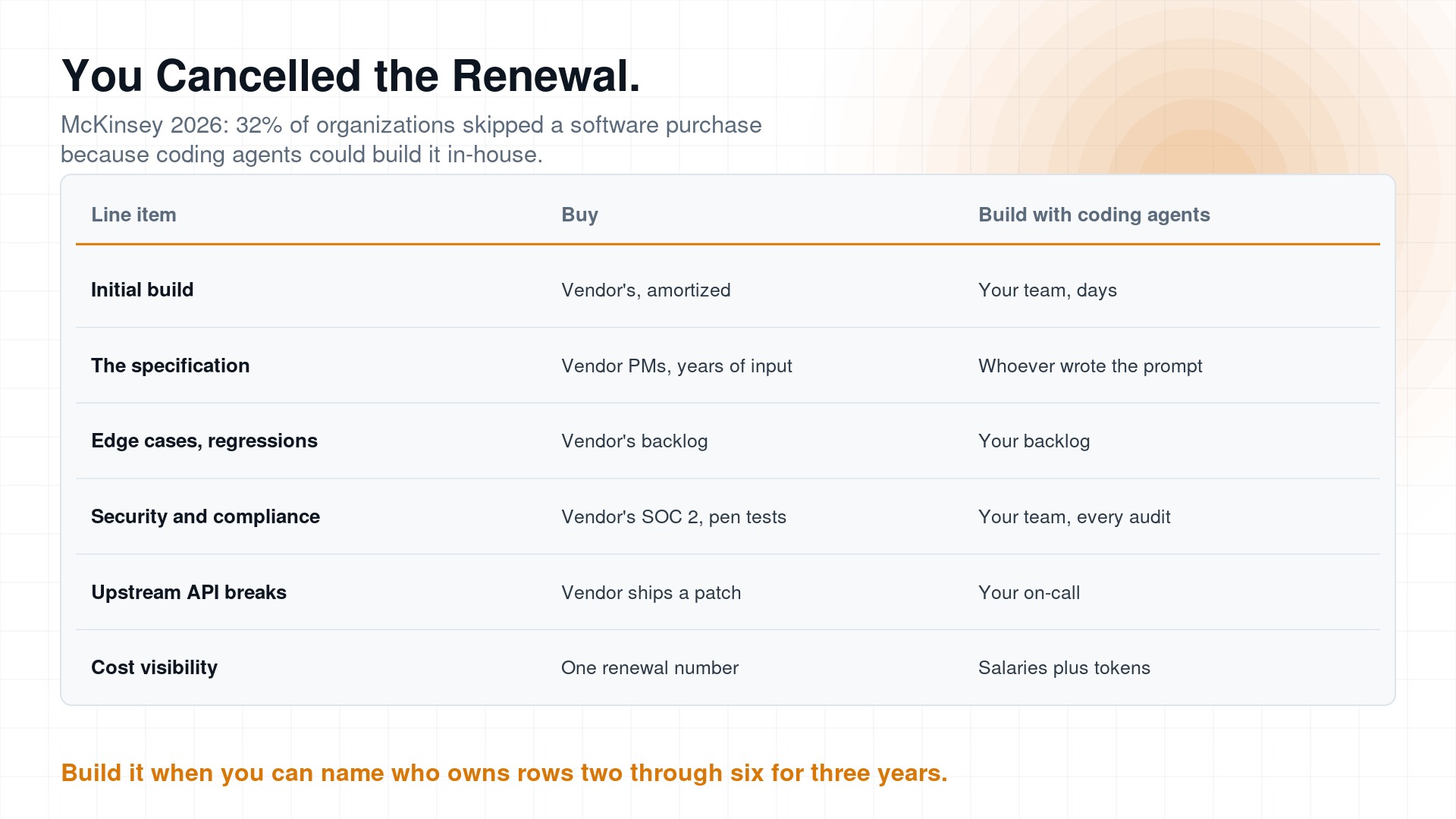
McKinsey's 2026 State of AI survey, published August 25, found that 32% of organizations decided against buying at least one software product or feature because they could build it in-house with agentic coding tools. Among the 6% McKinsey classifies as AI high performers, it was nearly half, against 31% for everyone else.
Cancelling the purchase order is the cheapest part of that decision.
Accurate as of September 2026.
Here is what the renewal line actually covered.
| Line item | Buy | Build with coding agents |
|---|---|---|
| Initial build | Vendor's, amortized across every customer | Your team, often in days |
| The specification | Vendor PMs, refined over years of customer complaints | Whoever wrote the prompt |
| Edge cases and regressions | Vendor's backlog | Your backlog |
| Security review, compliance evidence | Vendor's SOC 2, pen tests, questionnaires | Your team, every audit |
| Upstream API breaks | Vendor ships a patch | Your on-call |
| Cost visibility | One renewal number | Salaries plus tokens, usually untracked |
Build when you can name the person who owns rows two through six for the next three years. If you cannot name them, renew.
Retool's 2026 Build vs. Buy Report surveyed 817 builders and found 35% had already replaced the functionality of at least one SaaS tool, with 78% planning to build more this year. Retool sells the build path, so discount accordingly. Several of its numbers work against its own pitch.
Sixty percent of those builders shipped something outside IT oversight in the past year, and 25% do it regularly. Among organizational barriers to automating more work, unclear ROI led at 33%, budget at 30%, maintenance burden at 26%. And 35% of organizations had established no AI productivity metrics at all.
The cost you deleted had a number attached to it in a procurement system. The cost you picked up is spread across payroll and token spend, and nobody is adding it up.
The replacement work is also less automated than the framing suggests. Among Retool's respondents who shipped software with AI, 72% used it to write discrete pieces of code they integrated themselves, and only 31% prompted their way to a complete application. The leading assistants at work were GitHub Copilot at 39% and Cursor at 35%. Developers are doing this work with faster tools. You relocated the engineering cost, you did not remove it.
McKinsey shows where that lands. High performers scale coding agents at twice the rate of other organizations, and they report being constrained by the operating cost of those agents about three times as often. The teams furthest into this are the ones already hitting the bill.
The vendor sold you an accumulated specification. Thousands of customers' edge cases, compliance requirements, and permission models, encoded in a product over a decade. An agent hands you code. It does not hand you that.
Before you cancel the renewal, write the requirements document you would have sent to the vendor. If it takes an afternoon, build it. If you cannot finish it, you just found out what you were paying for.
Found this helpful? Share it with others!