Claude Now Puts an Invisible Watermark on Everything It Writes - Including Your Code
Anthropic is embedding an invisible, machine-readable signal into everything Claude generates, from prose to Claude Code output, to comply with the EU AI Act. For engineering teams, the watermark itself matters less than what it can and can't actually prove.
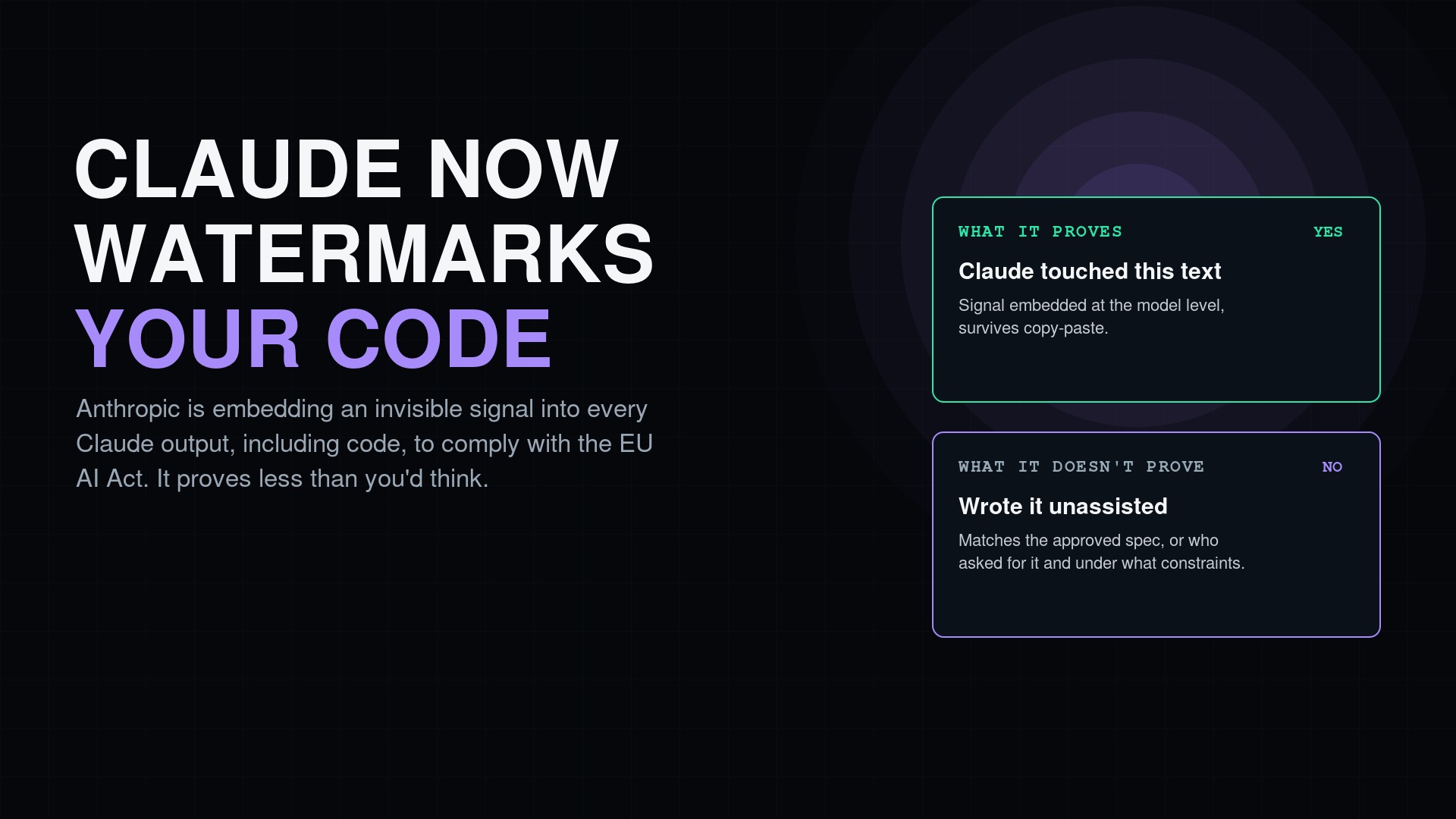
Starting with every Claude model released after August 2, Anthropic is weaving an invisible, machine-readable signal into whatever Claude writes - prose, code, all of it. The company confirmed it on an updated support page: the watermark lives inside the text itself, survives copy-paste, and applies across every surface - Claude, Claude Code, Claude Cowork, Claude Tag, the API. No opt-out.
The trigger is the EU's AI Act Transparency Code, which took effect August 2 and requires AI-generated content to be machine-identifiable. Anthropic is applying the mark worldwide, not just for EU users, and pairing it with C2PA-signed provenance metadata for files. Google, OpenAI, Meta, Microsoft, and others signed onto the same code, so this is the new baseline for the category, not an Anthropic quirk.
The backlash landed fast, and not from the group you'd expect. It wasn't students. It was lawyers, academics, and researchers who use Claude to copy-edit writing they wrote themselves, discovering that a full human draft now carries a machine mark because Claude touched three sentences of it. Coders raised a separate complaint: a cryptographic signature riding along in generated code, and what that does to the output.
Three things matter here for engineering teams, ranked by how much they change your week.
-
Your shipped code may already carry this mark, and you don't control the disclosure. If Claude Code wrote or touched a function, the watermark travels with it into your repo, and possibly into a client's repo, indefinitely. Any contract with a "no AI-generated code" clause just got a lot more testable, and not necessarily in your favor - quietly cleaning up AI-assisted code no longer removes the evidence.
-
The watermark is a provenance signal, not an authorship record. It says "Claude touched this text," not "Claude wrote this unassisted," and definitely not "here's the spec it was generated from." Anthropic itself warns that heavy edits, paraphrasing, or short passages can knock the signal out entirely. It's neither reliable enough to prove your team followed a real process, nor absent enough to assume it won't turn up somewhere you didn't expect.
-
This is what governance infrastructure looks like, and it's still only half the job. Detecting that an artifact touched an AI model answers one question. Regulators, auditors, and clients actually want three: who asked for it, under what constraints, and whether it matches what was approved. A spec-driven paper trail answers all three. A watermark answers the first one, and only sometimes.
None of this is really about Claude specifically. Every major model will carry some version of this mark by year's end, because the EU just made it mandatory and nobody wants to be the last holdout. Teams that already keep a real record of what they asked an agent to build, and why, will find the watermark just confirms what they could already prove. Everyone else is about to learn that "we never disclosed AI involvement" was never a policy. It was an absence of evidence, and that absence just got a lot easier to notice.
Found this helpful? Share it with others!