Meta's New Coding Agent Has a Cheap Tier. It Costs You Your Code.
Meta launched Muse Code, a terminal-based coding agent, with a discounted 'contributor' tier that trades a lower price for the right to train on your prompts and completions. That's a data licensing decision dressed up as a pricing plan.
Meta launched Muse Code this month, a terminal-based coding agent that installs with one command and takes on full engineering tasks: planning a change, writing it across a large repo, checking the result. It runs on Muse Spark 1.2, a coding model Meta co-trained alongside the agent, and it's the fourth major lab in a category that had no room for a new entrant a year ago, after OpenAI, Anthropic, and Microsoft's now in-house Project Polaris.
The technical pitch is standard for 2026: multiple agents working a task in parallel, persistent background runs that keep going while you do something else, reviewer agents watching the work happen. The pricing isn't standard.
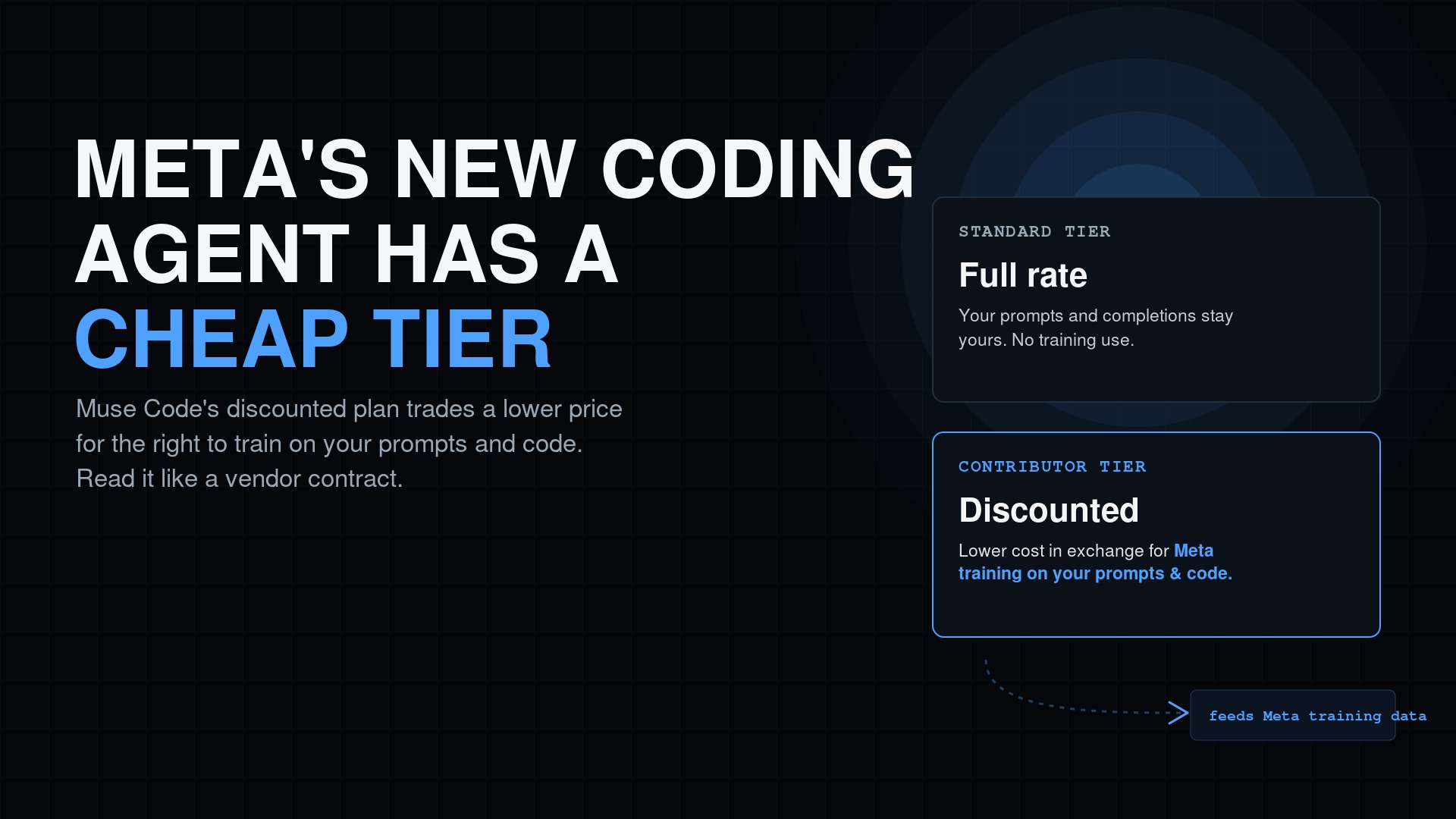
Muse Code ships two tiers: a standard rate, and a "contributor" tier priced meaningfully lower in exchange for letting Meta train on your prompts and completions. The Register put it plainly: Meta wants inside your terminal, and it's subsidizing the ticket price for the data that gets it there.
Ranked by who should care most about that tradeoff.
-
This is a data licensing decision wearing a pricing plan's clothes. Every prompt and completion on the contributor tier becomes training data. For most codebases that means proprietary logic, internal API names, and business rules flowing into a model you don't control. The discount is real. So is what you're handing over to get it.
-
Procurement and legal need visibility before an engineer opts in for the cheaper rate. Nobody sets out to leak IP through a pricing toggle. But a contributor-tier signup made inside a terminal by a developer trying to save the team money is exactly the kind of decision most orgs have no gate for. If your AI tool approval process checks security and skips the pricing tier's data terms, that's the hole.
-
A fourth serious lab entering coding agents is good for leverage, bad for standardization. More competition usually means better tools and lower prices. It also means more agent behaviors, more prompt formats, and more model quirks to account for if your workflow assumes any one vendor's agent under the hood. Teams handling this well keep the process - the spec, the test, the definition of done - independent of which agent runs it that week, the same discipline that matters when a vendor swaps a model out from under you without warning.
Meta entering the market confirms agentic coding is infrastructure now, not a bet. Read the pricing tiers as carefully as you'd read a vendor contract, because that's what they are.
Found this helpful? Share it with others!