Four Projects Joined the Agent Standards Foundation. Two of the Big Three Do Not Use Them.
Alibaba, OpenAI, Anthropic and Hugging Face all donated a project to the Agentic AI Foundation in the same week. Here is what each one actually does, which are safe to adopt now, and why the interoperability pitch has a hole in it.
Accurate as of October 2026.
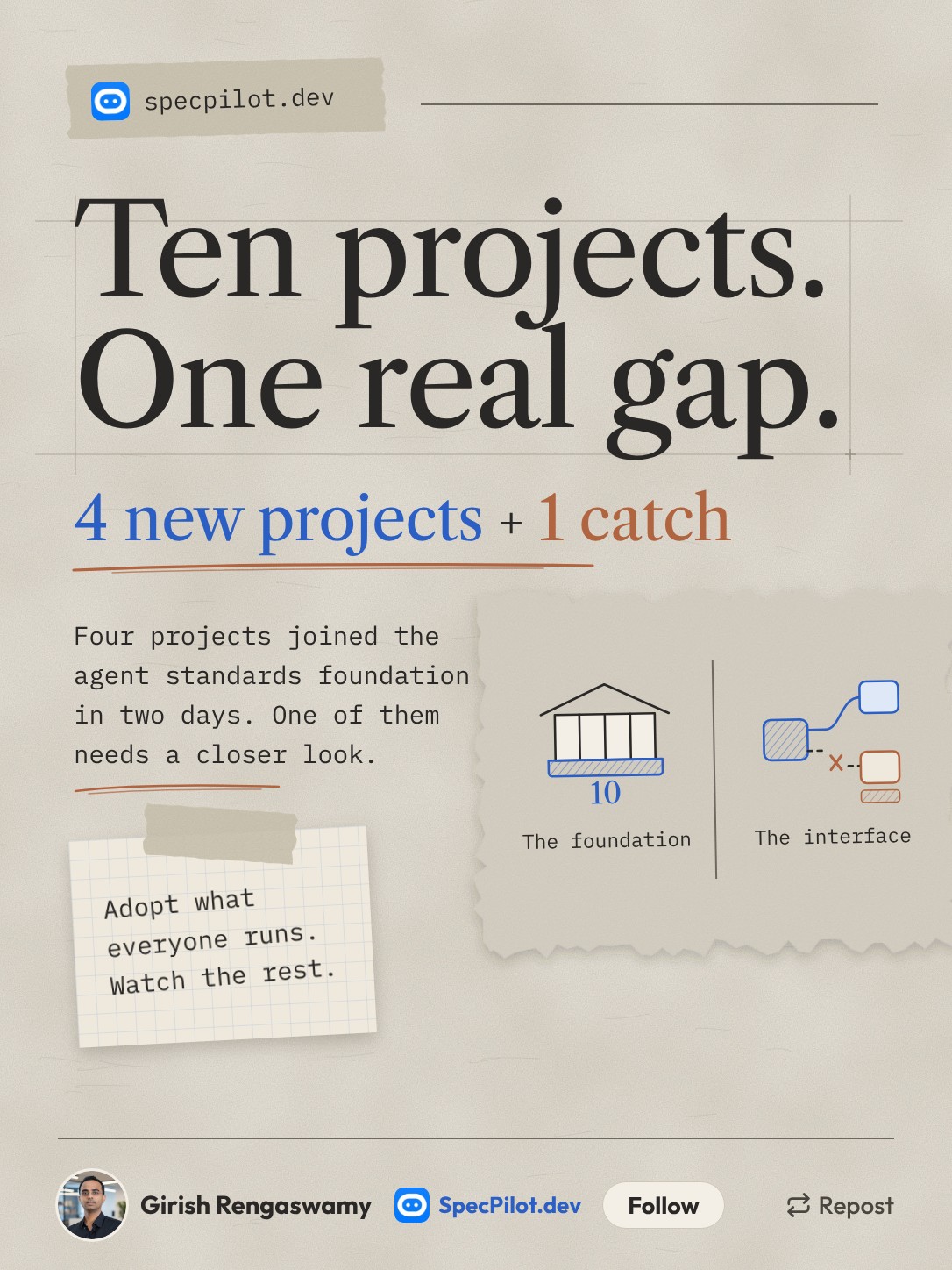
Four companies that compete with each other handed a project each to the same foundation on the same day. That is worth ten minutes of your attention, because one of the four is about to become a file format you will meet whether you choose it or not, and another is being sold as an interoperability win that two of the three biggest model vendors have not actually adopted.
All four landed at AGNTCon and MCPCon North America in San Jose on 22 and 23 October.
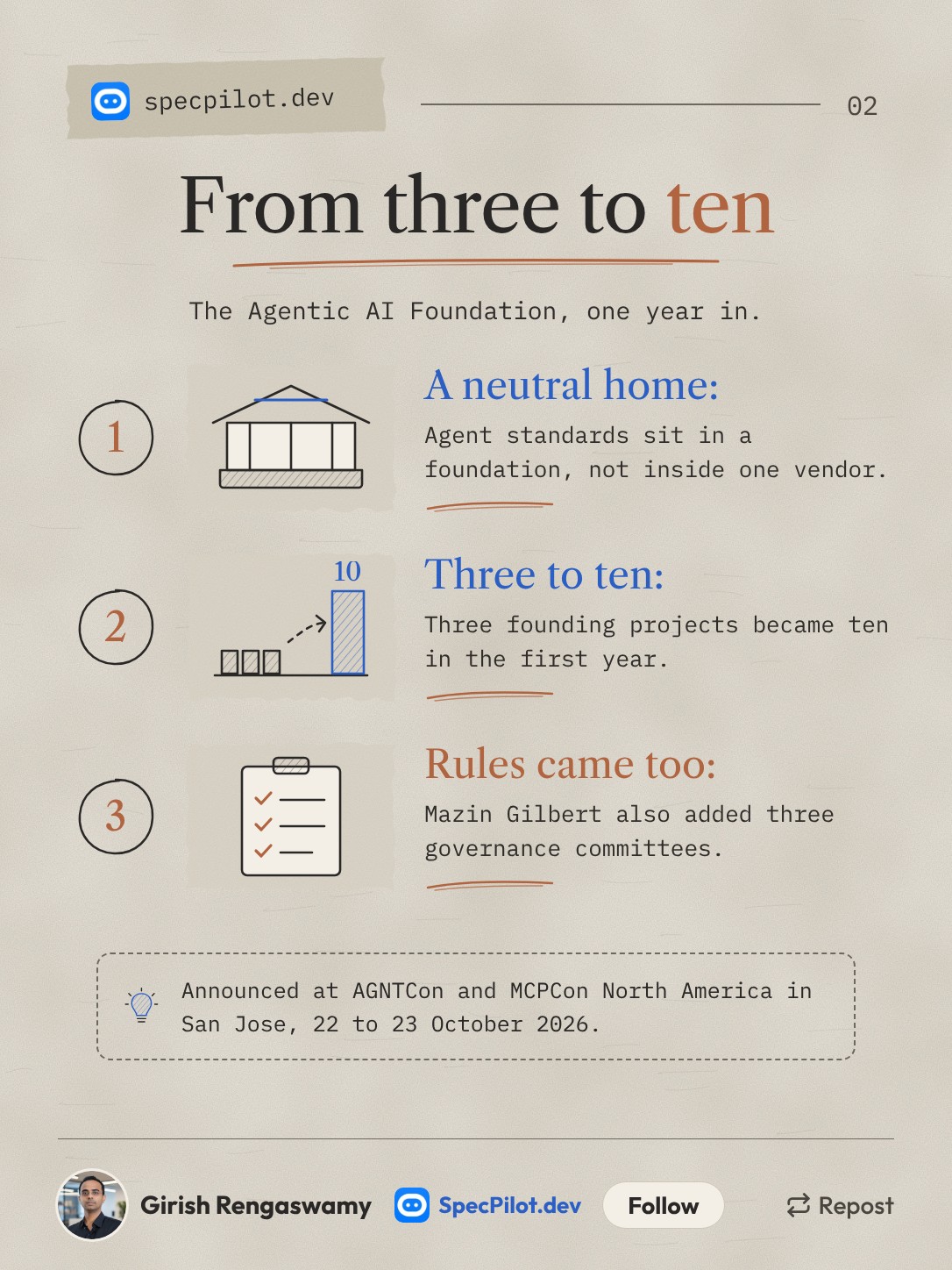
The Agentic AI Foundation went from three projects to ten in its first year. Manik Surtani, its CTO and co-founder, described the original bet as agentic AI needing "a neutral home to thrive", and framed these four donations as four companies choosing neutral governance with "no single company controlling the outcome". Per InfoQ's conference report, executive director Mazin Gilbert also announced three new governance committees alongside the projects.
Neutral governance is the real product here. The code matters less than who gets to change it.
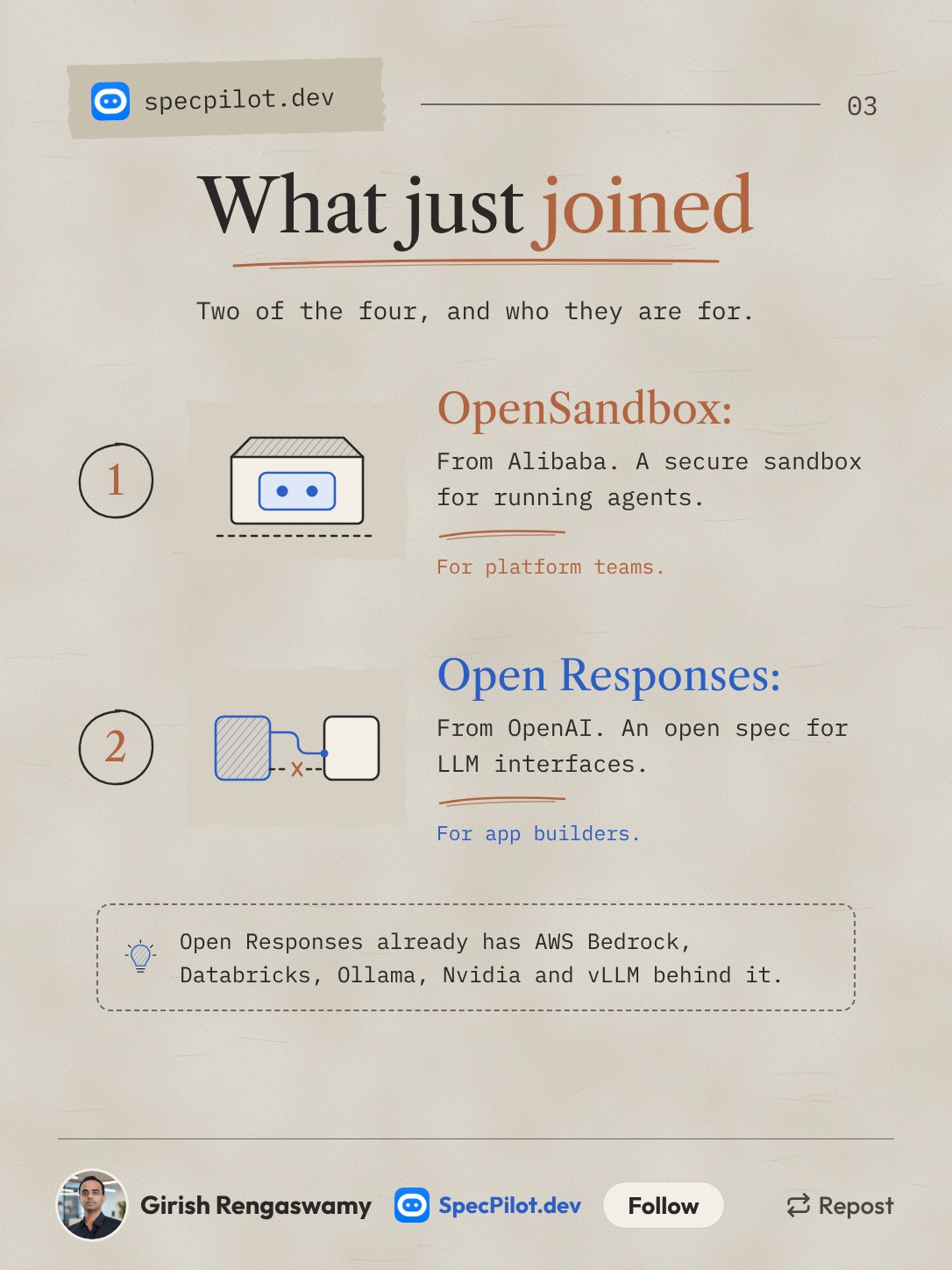
OpenSandbox, from Alibaba, is a general-purpose sandbox platform for AI applications. Multi-language SDKs, unified sandbox APIs, Docker and Kubernetes runtimes, and a lifecycle and execution protocol that lets you plug in custom runtimes. If you are running other people's agent code, this is infrastructure you would otherwise build badly yourself.
Open Responses, from OpenAI, is an open specification for multi-provider LLM interfaces, based on the OpenAI Responses API. Shared schema, consistent streaming events, extensible tooling. Write the request once, run it across providers. It already has AWS Bedrock, Databricks, Ollama, Nvidia and vLLM behind it.
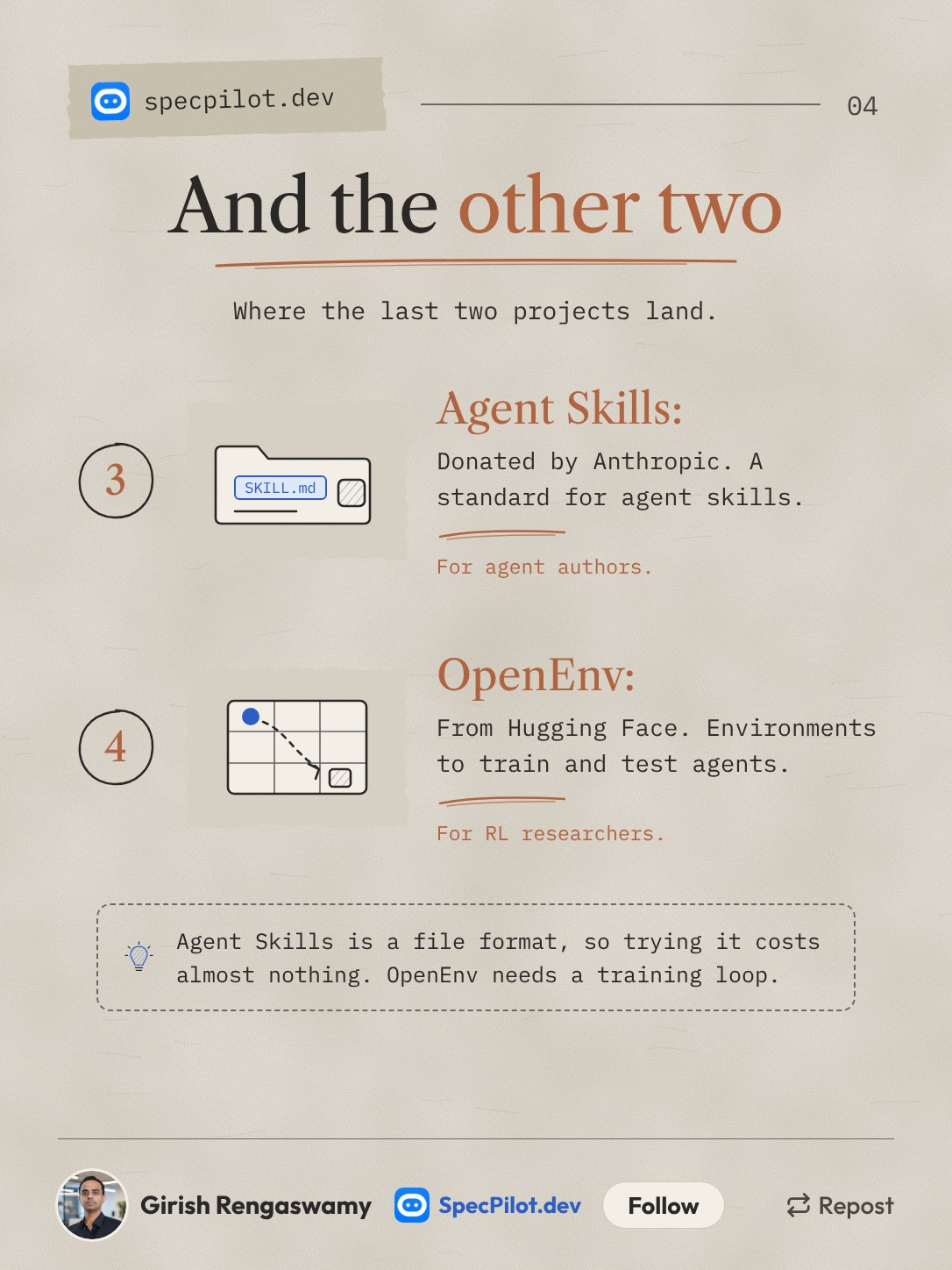
Agent Skills, donated by Anthropic, is an open format for packaging instructions, scripts and resources that an agent loads on demand. The point is portability: specialised know-how moves between agent products instead of being locked to one vendor's prompt box.
OpenEnv, from Hugging Face, is a framework and community hub for reinforcement learning environments. It wraps an environment in a containerised service exposing an agent interface, MCP, and Gym-style training protocols. Narrower audience than the other three, and it only earns its place if you are training agents rather than shipping them.
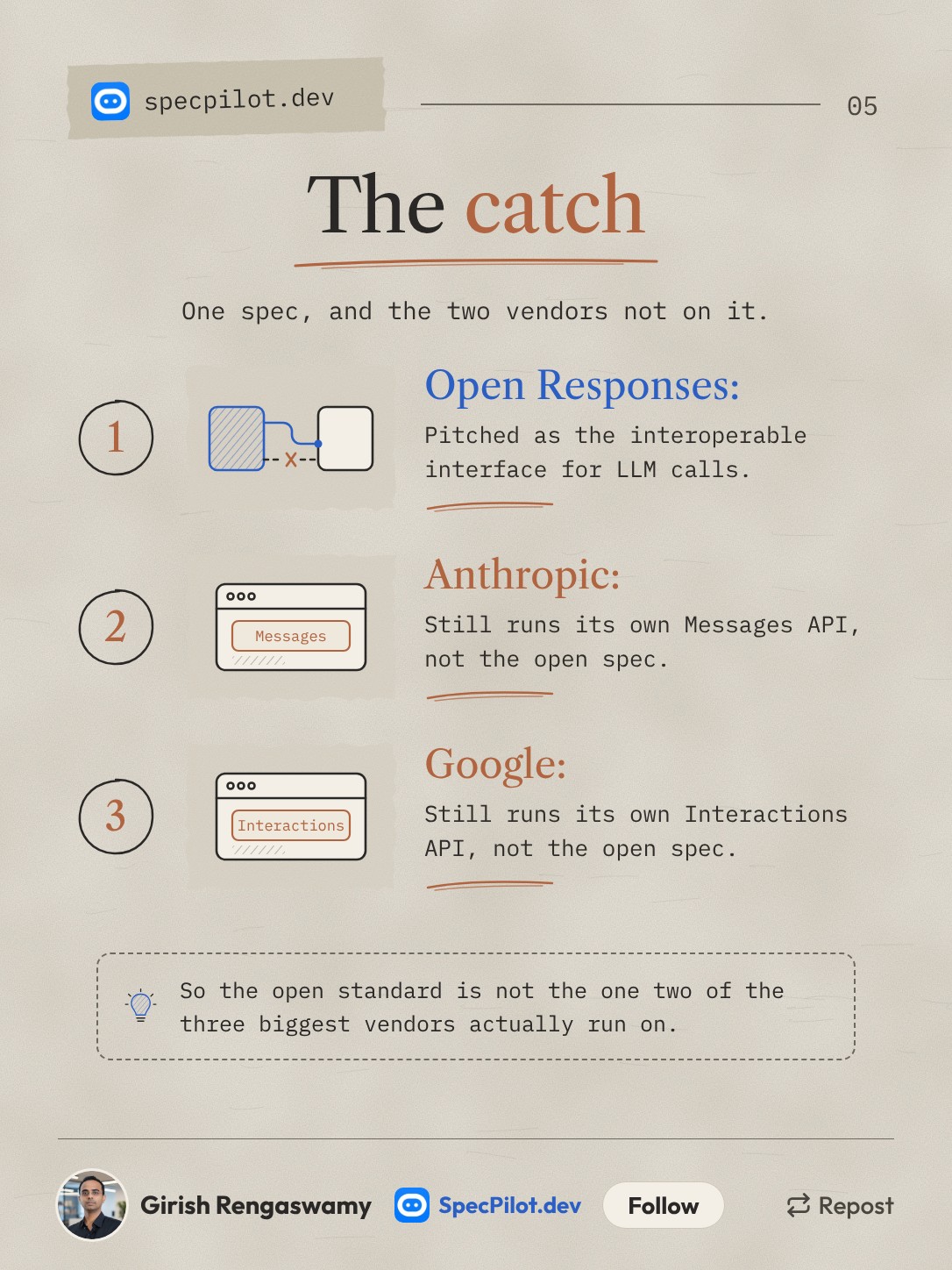
Here is the part the press release does not lead with. Open Responses is the one pitched as the interoperable interface for LLM calls. Anthropic still runs its own Messages API. Google still runs its own Interactions API. So the open standard for talking to model providers is not the one two of the three largest model providers actually serve.
That does not make it worthless. It makes it a strong convention among the hosting and inference layer rather than a settled standard. Plan accordingly.
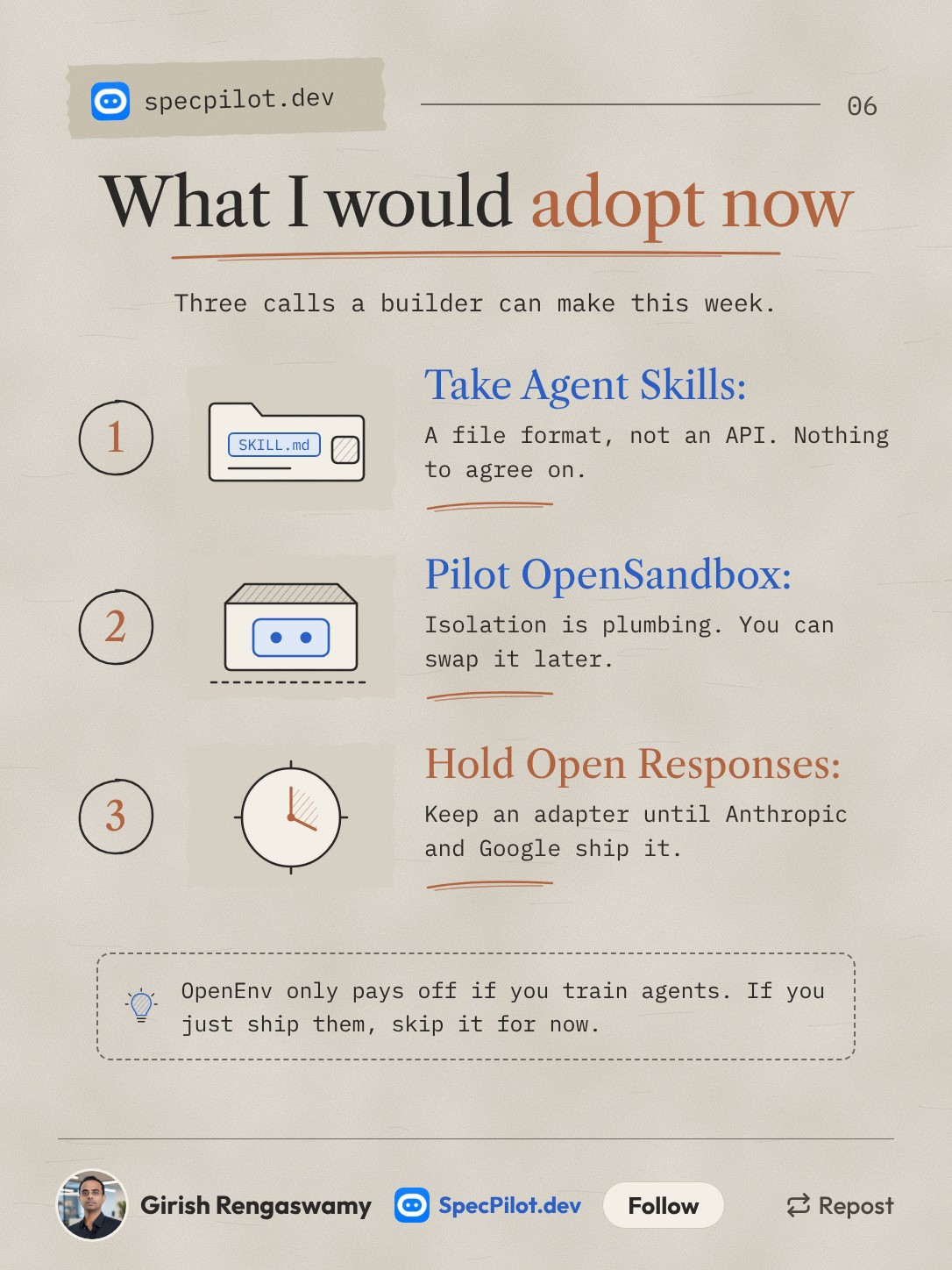
My read, as someone deciding what to put in a stack this quarter:
| Project | Contributed by | What it is | Verdict now |
|---|---|---|---|
| Agent Skills | Anthropic | Packaging format for agent instructions and scripts | Adopt. It is a file format, not an API. Nothing to agree on and almost nothing to lose |
| OpenSandbox | Alibaba | Sandbox platform with Docker and Kubernetes runtimes | Pilot. Isolation is plumbing, and plumbing is swappable later |
| Open Responses | OpenAI | Multi-provider LLM interface spec | Hold. Keep an adapter layer until Anthropic and Google ship it |
| OpenEnv | Hugging Face | RL environments for training and evaluating agents | Skip unless you train agents. It needs a training loop to pay off |
The rule underneath that table: adopt formats freely, adopt protocols cautiously. A format you can abandon in an afternoon. A protocol wires itself through everything you own.
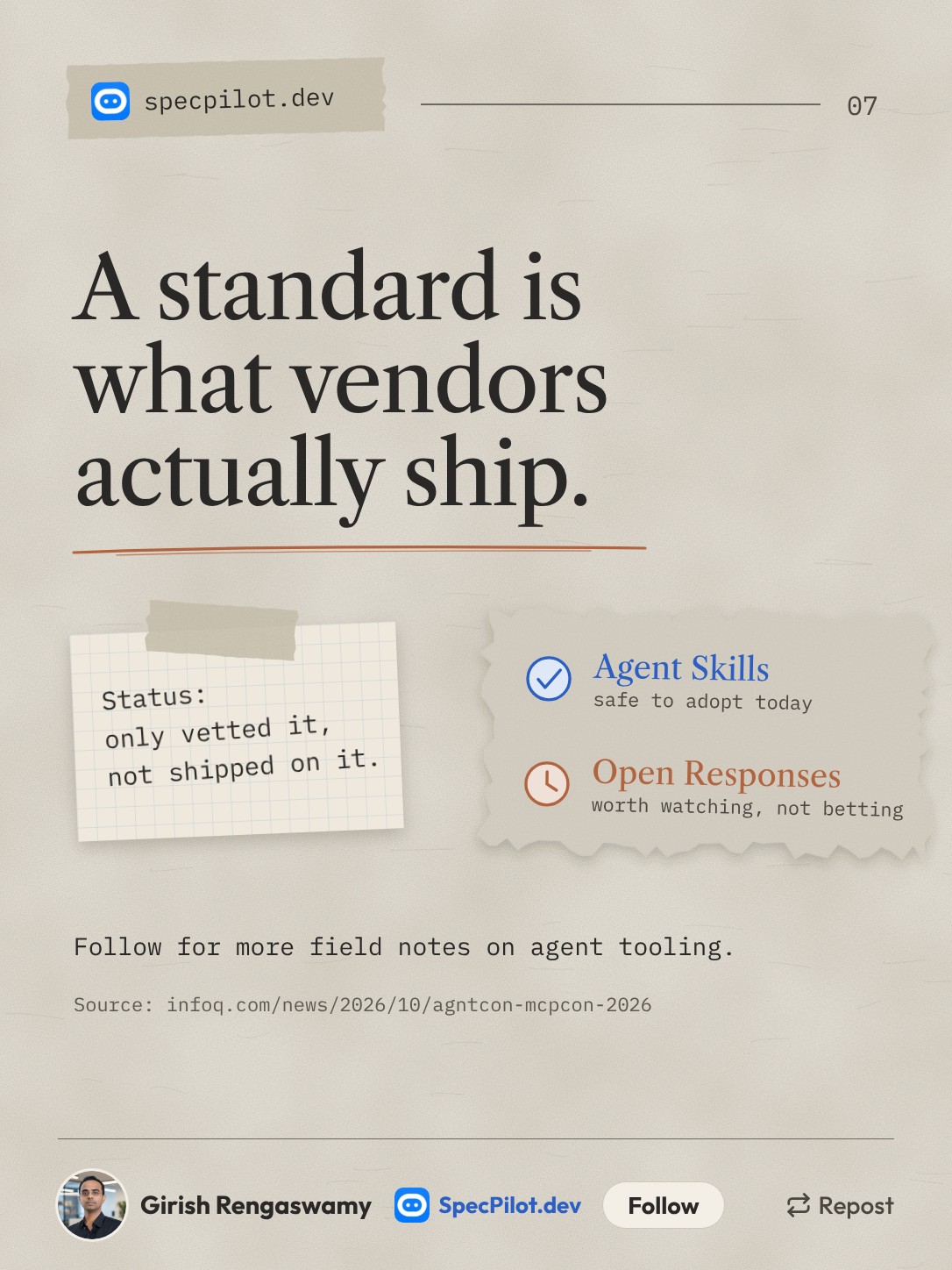
Status on this one: only vetted it, not shipped on it. I read the announcements and the conference coverage. I have not run a production workload on any of the four.
The full ten, for context
The four new arrivals join six existing projects, and seeing the whole set makes the foundation's shape clearer than any single announcement does.
| Project | Layer it sits at |
|---|---|
| Model Context Protocol (MCP) | How agents reach tools and data |
| Agent2Agent (A2A) | How agents talk to each other |
| Agent Router | Where a request gets sent |
| agentgateway | What sits in front of your agent traffic |
| AGENTS.md | How a repo tells an agent what it is |
| goose | An agent client |
| Agent Skills | How capability gets packaged |
| Open Responses | How you call a model |
| OpenSandbox | Where agent code runs safely |
| OpenEnv | How agents get trained and evaluated |
Read down that list and the gap is obvious. There is good coverage of how agents connect, call and run. There is still nothing here that governs what an agent is supposed to build before it starts building it.
A standard is what vendors actually ship, not what they donate. Check which of these your model provider serves before you write code against any of them.
Found this helpful? Share it with others!