GitHub Copilot Just Swapped Its Brain. Could You Tell If It Got Worse?
Microsoft's Project Polaris replaced GPT-4 Turbo as GitHub Copilot's default model this month, with gains landing unevenly across languages. Teams with no fixed baseline to test against won't notice a regression until it's already in production.
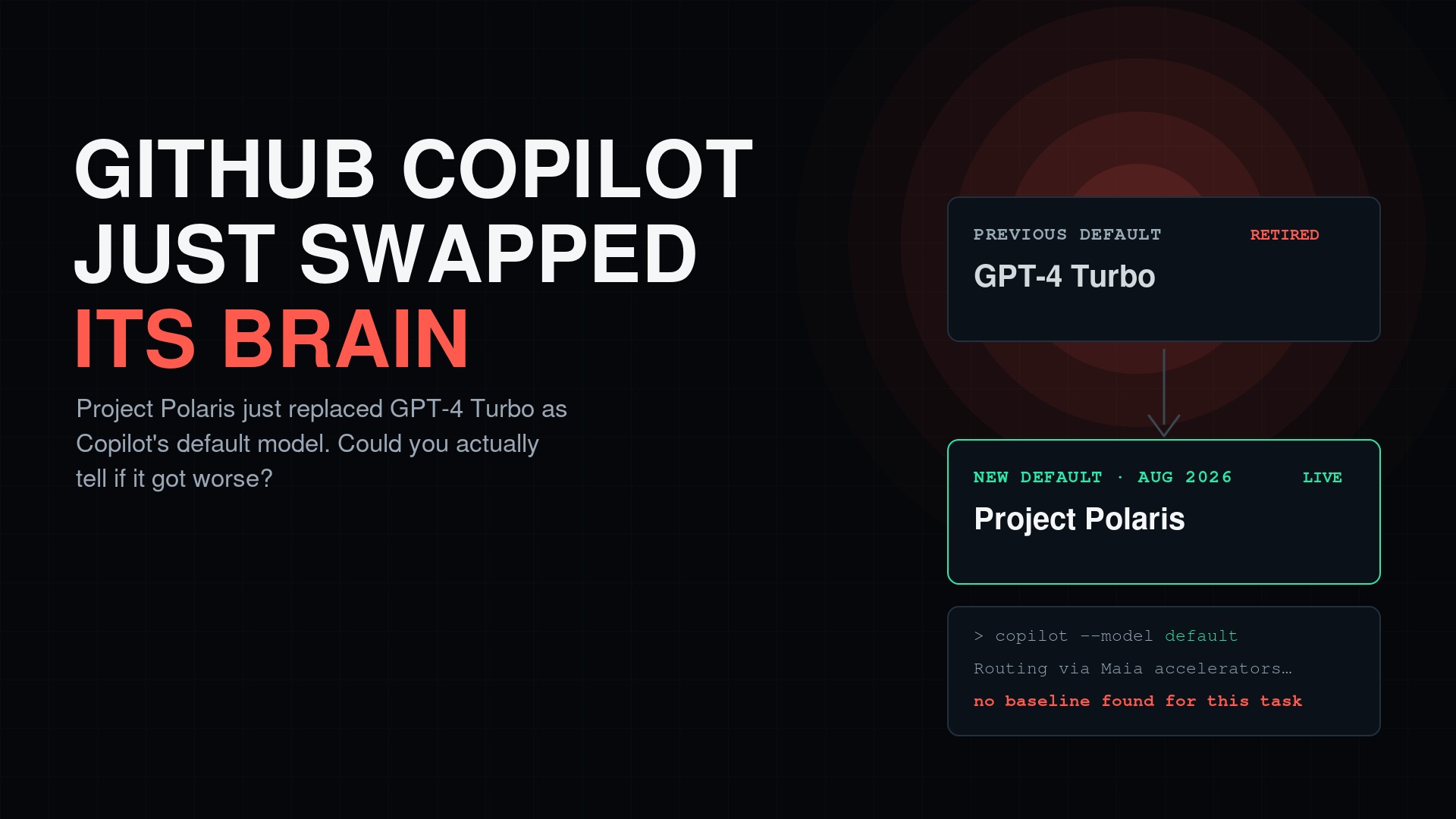
This month, Project Polaris became the default model behind GitHub Copilot, quietly replacing GPT-4 Turbo for every subscriber who didn't opt out. Announced at Build in June, it's Microsoft's first in-house coding model, a mixture-of-experts system running on their own Maia accelerators instead of routing every completion through OpenAI's API.
The stated reason is quality: Microsoft claims Polaris beats GPT-4 Turbo on HumanEval and MBPP, with the biggest jumps in low-resource languages like Rust and Haskell. The unstated reason is control. Copilot is GitHub's highest-volume product, and Microsoft just cut the meter that ran through a competitor's infrastructure and pricing.
What matters more is what happens on your team the week the switch flips and nobody says anything.
Independent verification of those benchmark claims hasn't caught up yet, and "biggest gains in Rust and Haskell" also means the gains aren't spread evenly. If your stack is Python and TypeScript, the model behind your daily completions changed and there's no public number telling you whether it moved up, down, or sideways for your actual codebase. Microsoft is giving enterprise tenants a three-month fallback to GPT-4 Turbo through November. That safety net is a tell: they're not confident enough in a clean cutover to skip it.
Three things most teams aren't set up for, ranked by how much they'll cost you if ignored.
- You have no baseline to test the new model against. If "good Copilot output" has only ever lived in your head or in Slack threads about which suggestions felt right, you can't compare last month's model to this month's. A spec that defines what correct output looks like for a given task is the only artifact that lets you run the same test against two different models and get a real answer instead of a vibe.
- Silent model swaps are now a permanent feature of this category. Cursor, Windsurf, and Copilot have all changed default models more than once in the past year, with varying amounts of notice. Betting your workflow on one model's specific quirks is building on sand. A process that states intent independently of which model executes it survives the swap.
- Use the three-month fallback window to test, not to wait. Enterprises with a fixed baseline can run the same task set against Polaris and GPT-4 Turbo side by side before November and catch regressions while rollback is still one setting away. Let the window pass and you're debugging a quality drop with no comparison point and no way back.
Microsoft ending its dependence on OpenAI for Copilot is a real strategic move, worth watching regardless of what tool you use. For engineering teams, the bigger lesson has less to do with Microsoft or OpenAI. The model under your coding agent is not a fixed asset. It will change again, probably with little warning. The teams who catch a regression before their users do are the ones who wrote down what "correct" means before they needed to check.
Found this helpful? Share it with others!