Google Just Stopped Selling Gemini Code Assist. Check Your Renewal Date.
On October 9, Google ended new sales of Gemini Code Assist Standard and Enterprise and pointed buyers to Antigravity. If your team standardized on it, you now have a migration to plan.
On October 9, Google stopped selling new Gemini Code Assist Standard and Enterprise subscriptions. Existing subscriptions keep auto-renewing through the rest of 2026, and auto-renewal stops in 2027. Google's suggested replacement is Antigravity, available through eligible Gemini Enterprise subscriptions and the Gemini Enterprise Agent Platform.
This did not come out of nowhere. It is the last step of a retirement that started in the spring.
The three-step shutdown
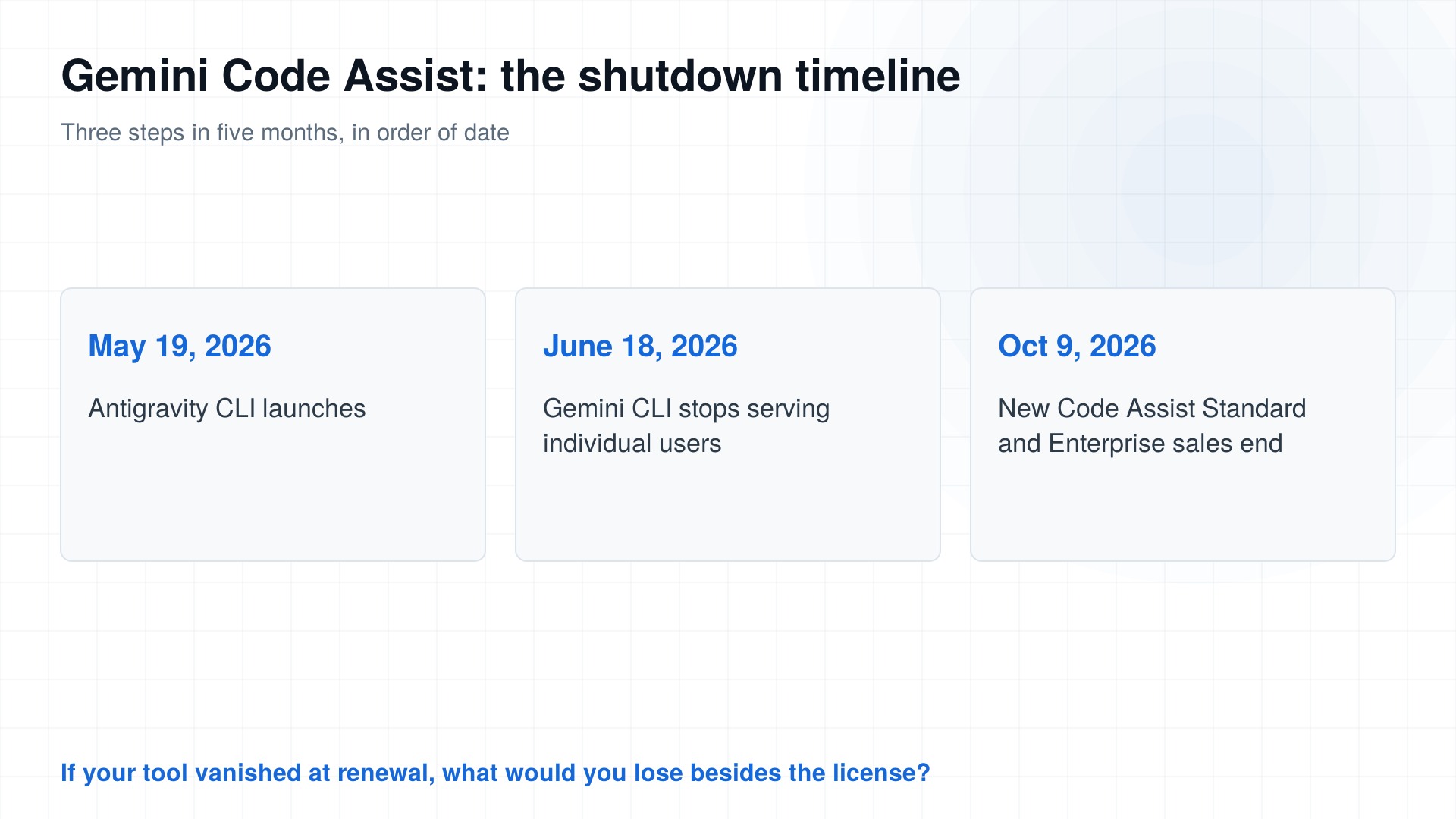
| Date | What happened |
|---|---|
| May 19, 2026 | Antigravity CLI launched as the terminal front end of Google's agent-first Antigravity platform |
| June 18, 2026 | Gemini CLI and the Code Assist IDE extensions stopped serving Google AI Pro, Google AI Ultra, and free individual users |
| October 9, 2026 | New Standard and Enterprise Code Assist sales ended |
Source for the first two rows: Google's Gemini CLI to Antigravity CLI announcement.
Rule: if a vendor shuts down its individual tier first, assume the paid tiers are next, and start the migration plan then.
What this means for your team
- Check your renewal date today. Existing contracts renew through 2026 and stop in 2027. Google's note does not state transition pricing or migration tooling, so ask your account rep for both in writing.
- Test Antigravity CLI before you commit. It is built in Go, runs multiple agents including background refactors, and keeps Agent Skills, Hooks, and Subagents. Google's own post says it does not yet have full feature parity with Gemini CLI, so list the features you rely on and check each one.
- Follow the migration guide. Enterprise users can already point Antigravity CLI at their Google Cloud projects.
- Move your instructions out of the vendor. Skills, hooks, and prompts that live only inside one tool's config are the part you will rewrite. Keep your specs and project rules in plain markdown in the repo.
The real lesson
Google is not the only vendor doing this. Tools get renamed, folded into bundles, and retired inside a single year, and Gemini Code Assist is one more example. Teams that got hurt are the ones whose workflow lived inside the product.
Teams whose requirements, acceptance criteria, and project context sit in the repository can swap the agent underneath and keep working. That is the whole argument for writing the spec first.
Audit one thing this week: if your current AI coding tool disappeared on its renewal date, what would you lose besides the license?
Found this helpful? Share it with others!