OpenAI Just Cut Frontier Coding Prices by 80%. Don't Switch Yet.
GPT-6.1 Sol claims near-Astra coding scores at a fifth of the token price. The numbers are real, but they come from OpenAI's own evals, so run your own before you move a team.
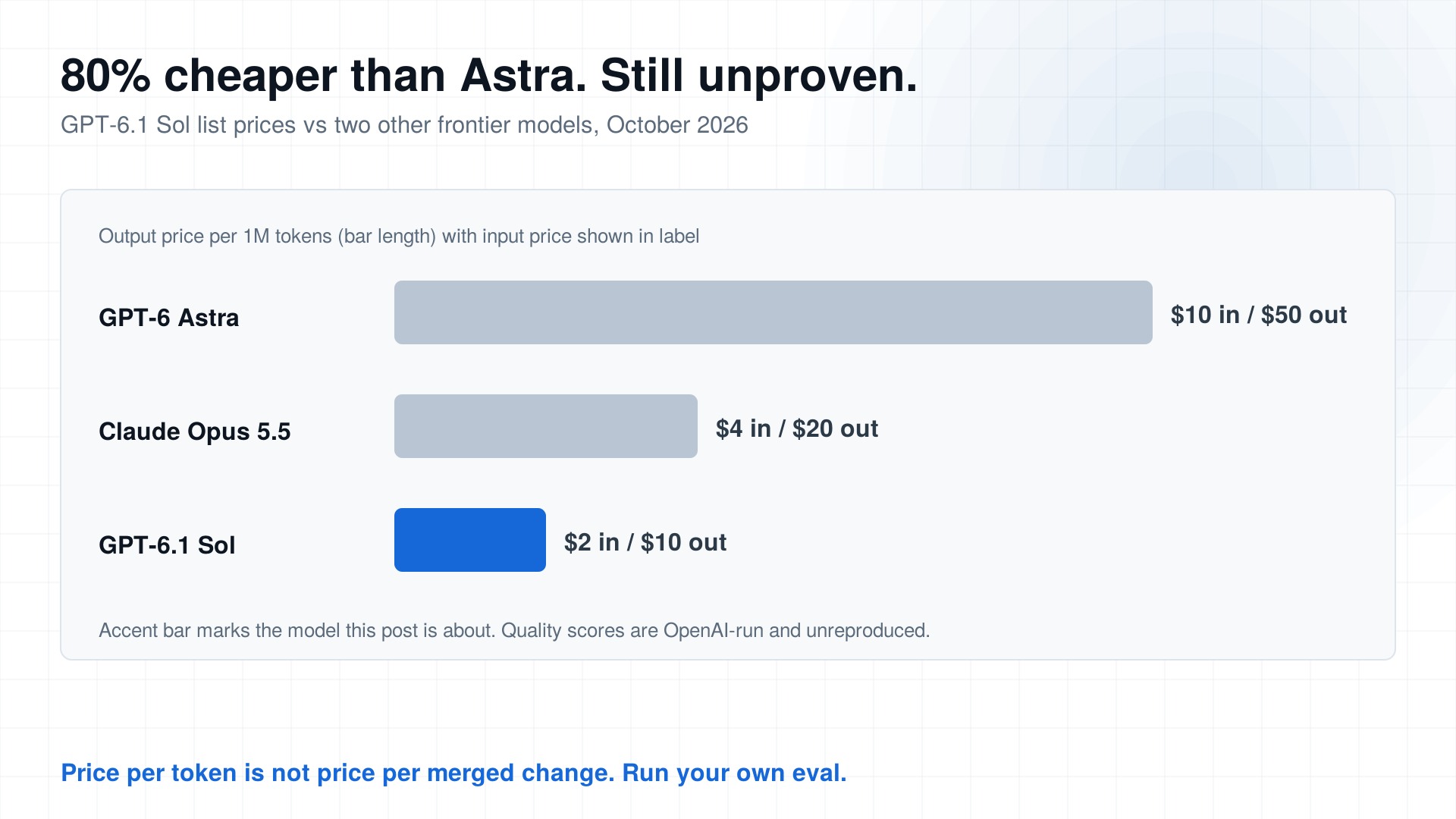
At DevDay on September 29, OpenAI shipped GPT-6.1 Sol, a model it says matches GPT-6 Astra on coding at roughly one-fifth of the cost. If you pay an AI coding bill, that sentence should get your attention. It should not get your migration plan yet.
What the price list says
Accurate as of October 2026. Per million tokens, from OpenAI's announcement and Anthropic's pricing docs:
| Token type | GPT-6.1 Sol | GPT-6 Astra | Claude Opus 5.5 |
|---|---|---|---|
| Input | $2.00 | $10.00 | $4.00 |
| Output | $10.00 | $50.00 | $20.00 |
| Cached input | $0.10 | $1.00 | $0.20 |
Sol is exactly one-fifth of Astra on every line. It is also half the list price of Opus 5.5 on every line.
Rule: compare cost per finished task, not cost per token. A cheap model that needs three attempts is not cheap.
What OpenAI claims about quality
On DeepSWE v1.1, a software engineering benchmark, OpenAI says Sol matches Astra and beats the previous GPT-6 Sol by 6.4 percentage points. On Terminal-Bench Science 0.1 it says Sol doubles the old Sol's score at less than half the cost per task.
Those are strong results. They are also vendor-run results on benchmarks the vendor picked. Nobody outside OpenAI has reproduced them yet.
What to do this week
- Build a 20-task eval from your own backlog. Use closed tickets with known-good diffs. Public benchmarks do not know your monorepo, your test suite, or your naming conventions.
- Run Sol, your current model, and one rival on the same tasks. Record pass rate, retries, and total tokens per task.
- Price the result per merged change. This is the only number your CFO will care about.
- Try it in Codex before touching the API. Sol is available to Plus, Pro, Business, Enterprise, and Edu users in Codex. In the API the model ID is
gpt-6-1-sol. - Check the speed tier separately. The Ultrafast variant, which OpenAI says generates tokens up to 8x faster, was still listed as coming soon in the Sol announcement.
The part people will skip
The same DevDay refreshed the Codex CLI with voice steering and an /agents view for delegating and tracking several tasks at once. Cheaper tokens make running more parallel agents affordable, and that is where review becomes the bottleneck.
An 80% price cut does not reduce the number of diffs a human has to read. Specs and acceptance criteria written before the agents start are what keep that pile reviewable.
Run the eval on Friday, and let the invoice from your own tasks make the call.
Found this helpful? Share it with others!