HydraFusion Cuts Your Copilot Bill 67%. Read the Quality Column.
GitHub's new multi-model orchestration preview beats Claude Opus 5 on one of three coding benchmarks and undercuts it on cost in all three. That makes it a budget decision, and it makes your execution path variable in a way it wasn't before.
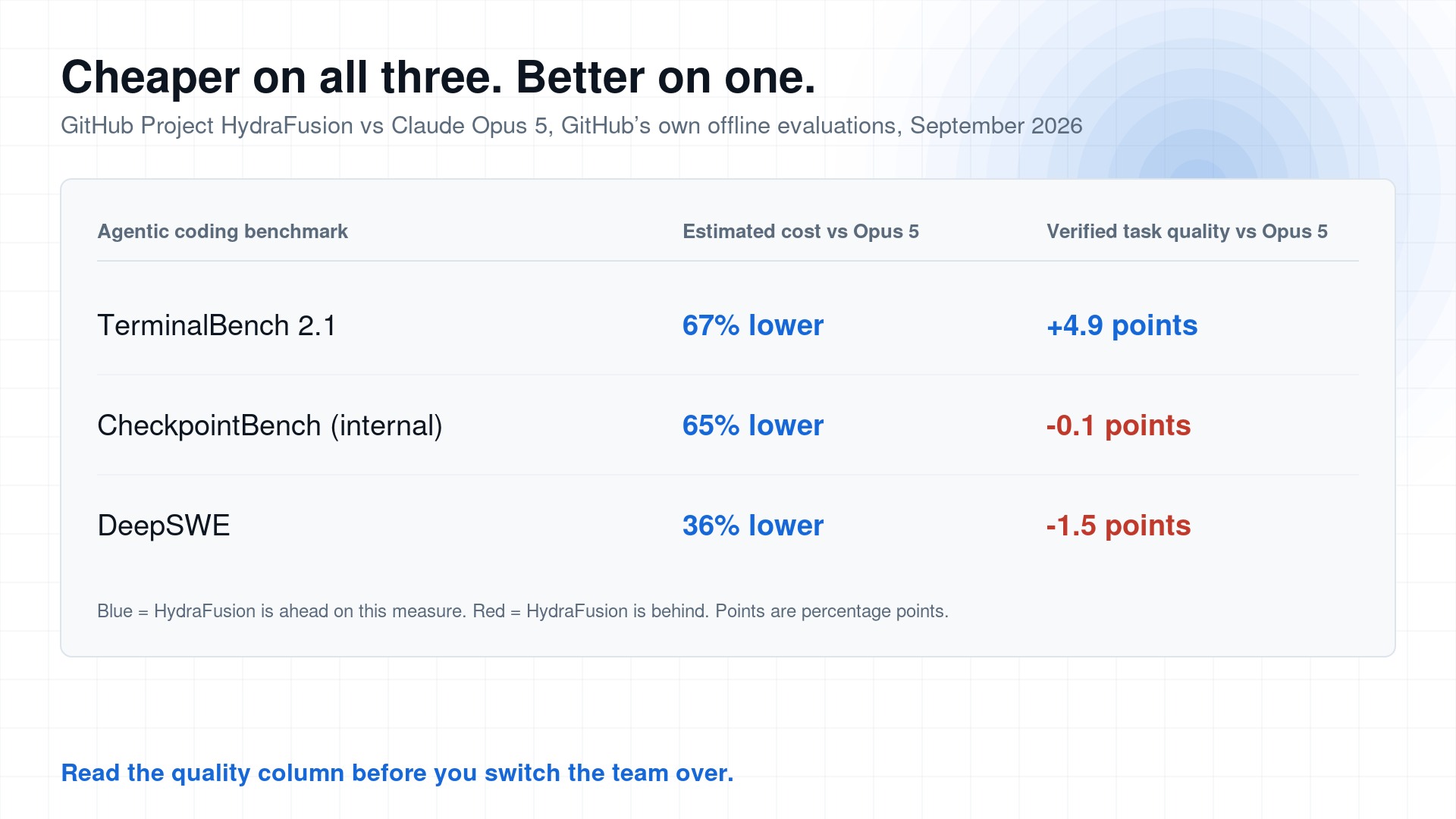
GitHub shipped Project HydraFusion on September 4 under the headline "frontier quality via multi-model orchestration." The benchmark table underneath that headline says something narrower and more useful.
Accurate as of September 2026.
HydraFusion is a research preview in GitHub Copilot CLI. Rather than run your task on one model, it builds an execution plan across providers: solve directly, draft cheap and escalate through a quality gate, or draft and hand the result to a read-only critic from a different model family for one round of revision. You select it like a model. It selects the workflow. That goes a step past auto model selection, which still picks a single model per task.
Here is GitHub's own offline evaluation against a Claude Opus 5 baseline.
| Benchmark | Cost vs Opus 5 | Quality vs Opus 5 |
|---|---|---|
| TerminalBench 2.1 | 67% lower | +4.9 points |
| CheckpointBench (GitHub internal) | 65% lower | -0.1 points |
| DeepSWE | 36% lower | -1.5 points |
Switch if your constraint is the Copilot bill. Stay on a single frontier model if your constraint is landing a hard repository-level change on the first attempt, because DeepSWE is the benchmark closest to that work and it is the one where HydraFusion gives up ground.
To try it, run /update in Copilot CLI, then /experimental on, then /model and select HydraFusion (Research Preview). It is open to every Copilot plan and billed by tokens consumed at each model's standard rate.
Three things to know before you route a team through it.
- Cost per task becomes variable. GitHub aggregates spend across every leg of the workflow, including drafting, critique, revision, escalation, retry, and fallback, then charges each model's normal rate. A task with a predictable price now costs whatever the router decided it needed. The average drops and the variance goes up.
- You cannot watch it work. HydraFusion reports workflow stages but withholds intermediate drafts until it returns one answer, since a discarded draft would read as final. GitHub calls the resulting wait a real trade-off for developers and says better progress reporting is on the way. Today you sit through the silence.
- These are GitHub's numbers from its best tuned configuration. The runs were offline, the cost figures are estimates, and CheckpointBench is GitHub's internal benchmark built from real Copilot sessions. Every model ran at medium reasoning, which is a fair control and also not how most teams run Opus on something hard.
What changed for engineering leaders is which parts of the system hold still. Pin a model and you get roughly the same execution path every time. Under HydraFusion the path changes per task, chosen by a policy GitHub tuned with beam search and plans to update whenever new models enter the pool. Same prompt, different workflow, different cost, possibly a different answer.
Your written definition of correct is the only fixed point left. With a spec and a replayable task set, you can check whether that -1.5 on DeepSWE shows up in your codebase. Without one, you are comparing this week's impressions against last month's.
Take your hardest recent ticket, run it through HydraFusion and your current model, and diff the two before you move the team.
Found this helpful? Share it with others!