Meta Built Its Best Coding Model and Kept It Off the API
Meta shipped two Muse Wonder models on October 12, but only the weaker one is available through an API. If your agent pipeline can't call a model, you can't eval it, route to it, or swap it out, and that makes it a risky thing to build on.
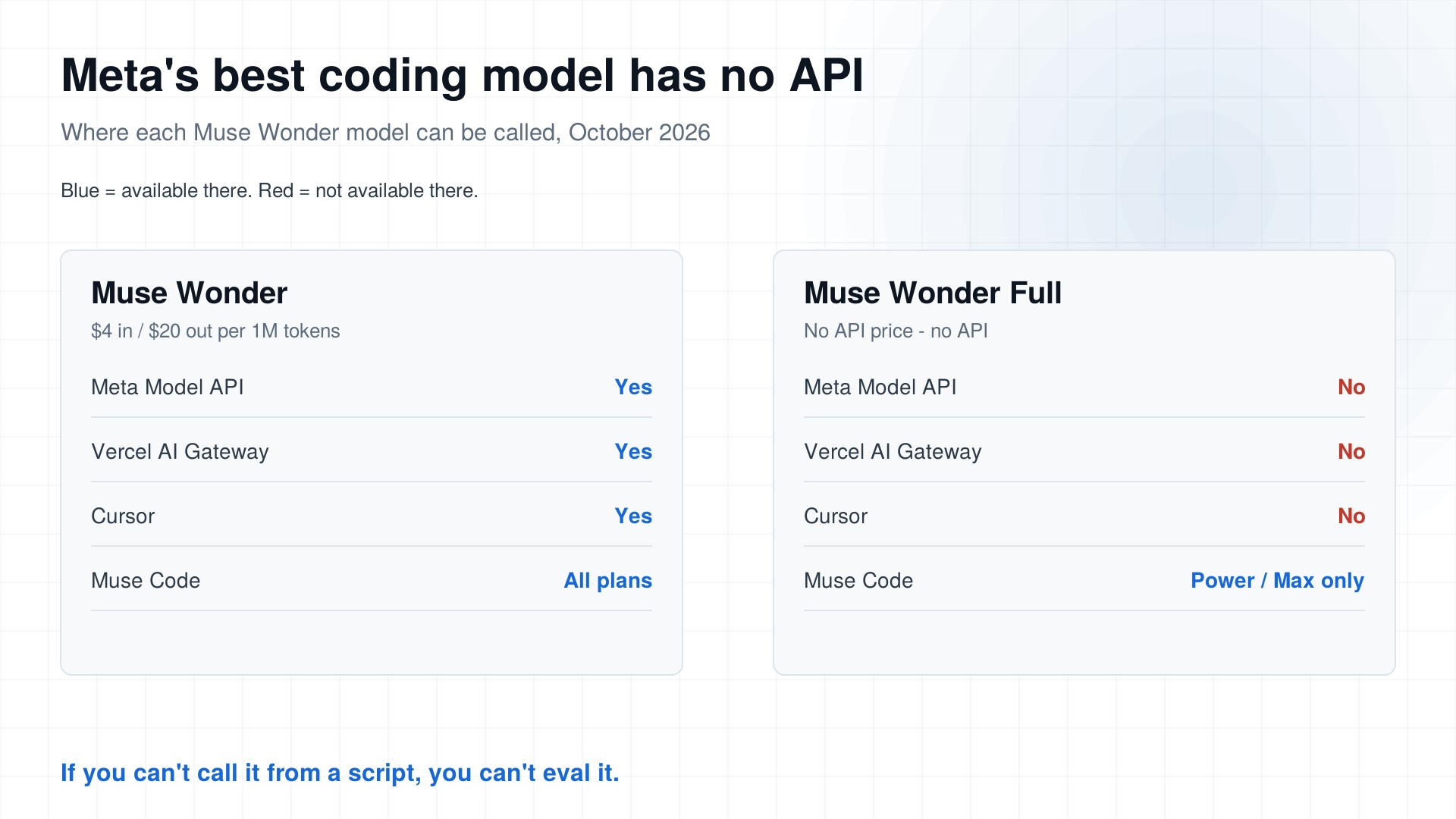
Meta released Muse Wonder and Muse Wonder Full on October 12, and the bigger one is locked inside Meta's own coding tool. You can pay for Wonder Full. You cannot call it.
Accurate as of October 2026.
What you can actually get
Muse Wonder is a normal model. It is on the Meta Model API at $4 per million input tokens, $0.20 cached input, and $20 per million output tokens, with a 1M token context window. Vercel AI Gateway lists it as meta/muse-wonder-1.0, and Cursor added it with a 300k default context and 1M in Max Mode.
Muse Wonder Full is different. Meta's own docs describe it as available through a Muse Code subscription only, on the Power Usage or Maximum Usage plans. There is no API price because there is no API.
| Where | Muse Wonder | Muse Wonder Full |
|---|---|---|
| Meta Model API | Yes, $4 in / $20 out per 1M tokens | - |
| Vercel AI Gateway | Yes, meta/muse-wonder-1.0 | - |
| Cursor | Yes, 300k default, 1M in Max Mode | - |
| Muse Code | All plans | Power Usage and Maximum Usage only |
Rule: if a model has no API, treat it as a product demo, not a dependency.
Why this matters more than the benchmarks
Meta says both models hit state-of-the-art results on agent, memory, and coding benchmarks, including SWE-Marathon for long-running software projects. Its announcement gives no scores in the text, so those are claims you can't check.
Even if they hold up, you can't run Wonder Full against your own repo, your own test suite, or your own specs. You can't put it behind a router, set a fallback, or log its failures next to another model's. The only way to evaluate it is to buy a seat and use it by hand.
That is the opposite of how a team should adopt a model. The sensible order is to eval it on your tasks, price it per run, then wire it in.
What to do instead
- Run Muse Wonder through the API on your own task set before anyone argues about Wonder Full. It is the model you could actually deploy, and it shows you how Meta's agent features behave on your code.
- Keep your specs and acceptance tests model-agnostic. A spec that any model can be graded against lets you switch the day Wonder Full gets an API, or the day it doesn't.
- Don't let a paid Muse Code seat become the default for the whole team. A subscription is a usage allowance, not a commitment that the model behind it stays the same.
Meta also describes two agent features, Active Memory for keeping context across sessions and Active Focus for working through blockers on long goals. Both sound useful, and neither is something you can measure from the outside right now.
Pick models you can test from a script. If you can't call it, don't plan around it.
Found this helpful? Share it with others!